The project that is fighting to decolonize the vision about nature in Uganda: “We need to be recognized and respected.”
After years of perseverance, indigenous communities have succeeded in getting the State to grant them authority to oversee fishing activities, but they need to go further
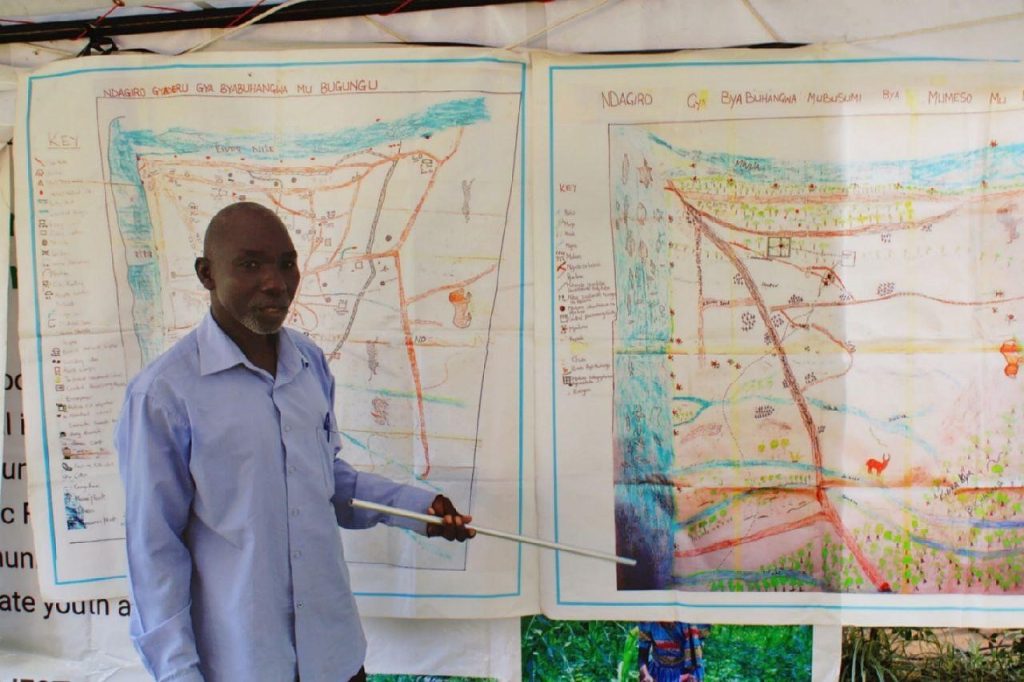
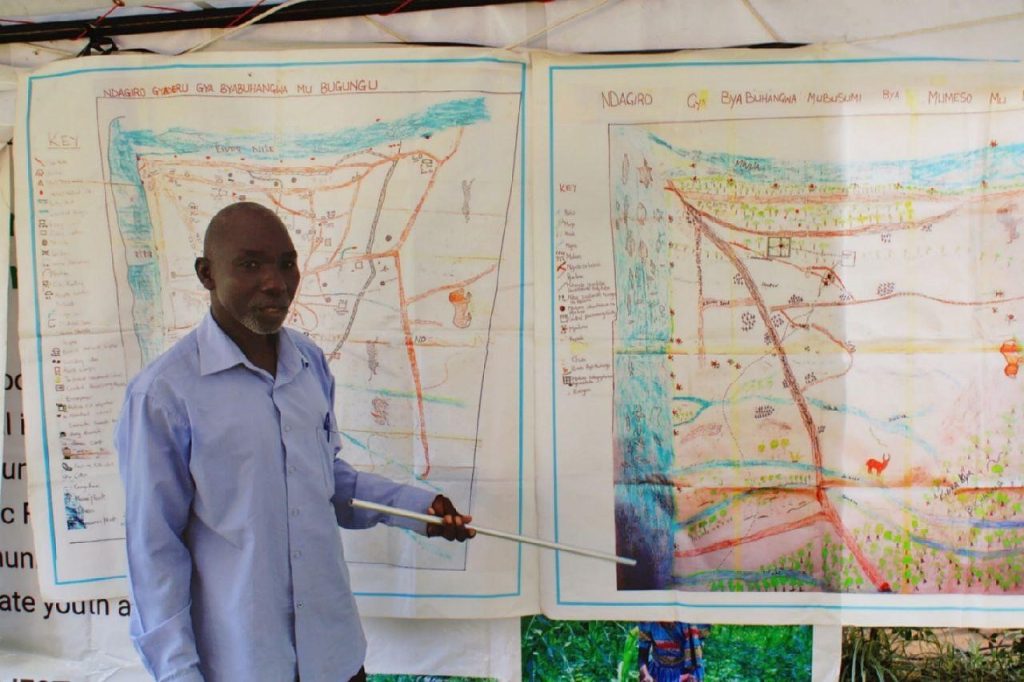
Guardian of one of the ‘sacred natural sites’ of the Bagungu community showing the ancestral maps made by the AFRICE organization.
What would happen if African indigenous communities who still dedicate their lives to protecting nature regained the self-esteem that colonial repression had robbed them of? This was the seed planted in the minds of Dennis Tabaro, a Ugandan agroecologist, and six others from Benin, Kenya,
Cameroon, Zimbabwe, South Africa, and Ethiopia at a meeting driven by the African Biodiversity
Network and the Gaia Foundation. From this, the African Earth Jurisprudence Collective was born.
“Although it may seem like a new term, Earth Jurisprudence is an ancient idea. The person who coined the term, Thomas Berry, was inspired by indigenous communities,” explains Carlotta Byrne, leader of the Earth Jurisprudence Program at the Gaia Foundation. “This type of jurisprudence has been described by the UN as ‘the fastest-growing legal movement of the 21st century,’” she explains.
This is a philosophical and legal movement that proposes that human laws must be in harmony with the laws of nature. “Indigenous cultures around the world have always understood this,” the foundation asserts. According to the Eco Jurisprudence Monitor, there are currently around 600 initiatives worldwide with this approach. Around 100 of them involve Indigenous communities.
This vision is also supported by entities such as the Intergovernmental Platform on Biodiversity and Ecosystem Services (IPBES), one of the leading scientific authorities in the field of biodiversity. In its latest report, they called for “challenging colonial structures” and “promoting and enhancing sustainable practices associated with Indigenous knowledge.” In essence, they encouraged the world to draw inspiration from these values as one of the ways to overcome the current ecosocial crisis.
And this is the path followed by people like Dennis Tabaro, who, after training, founded the African Institute of Culture and Ecology (AFRICE) to help restore the self-esteem of various Ugandan communities with indigenous roots, such as the Bagungu, the Basesse, and the Banyabutumbi.
The impact of colonization on environmental relations
The context in which he is doing so is tremendously significant: his struggle parallels the development of the construction of the world’s largest heated crude oil pipeline on Ugandan (and Tanzanian) land, the East African Crude Oil Pipeline (EACOP), a project that has faced (and continues to face) enormous criticism and protests and whose route passes through the Buliisa district, home to the Bagungu, the main indigenous community with which AFRICE is working.
But this is not the only threat facing the country’s biodiversity: Climate change caused by the global North, as well as other activities beyond oil, such as coal burning, large-scale agriculture, illegal logging, and the expansion of industrial infrastructure, are also having a major impact on various key ecosystems, as is, Tabaro insists, “the erosion of traditional cultural knowledge due to religious fundamentalism.”
In the Great Lakes region of Uganda, British colonization [1894-1962] left a huge mark on society’s view of nature, as has happened in so many other cases. “Nature used to be considered an integral part of Ugandan lives, just as it was for the rest of the humans. Nowadays, most people think it’s there for us to exploit,” Tabaro says.
Adele Stock, a historian specialized in Uganda, agrees: “In the 19th century, the arrival of Arab traders in Uganda began the process of transforming environmental relations, which was later intensified by the British Colonial Project. Today, some Ugandans view nature as a resource, and others use it as a resource because they have to, but they don’t necessarily view it that way, as is also the case in the West.”
Rescuing the precolonial perspective
It is estimated that only 2.70% of Ugandans still report having distinctly indigenous ways of life. In a scenario like this, AFRICE’s goal is to revive pre-colonial values particularly associated with nature. “We seek to integrate ancestral indigenous laws into conventional conservation laws. This is the task we are facing” the organization explains.
The specialist in Earth Jurisprudence describes the relationship with nature of the Bagungu community, with whom he collaborates the most, before the arrival of settlers: “Their culture revolved around this body of water [Lake Albert, the second largest in Uganda] and around the forests, rivers, and wildlife, with which they lived in harmony.”
He continues: “They believed their gods and ancestors lived in those forests and rivers and that they too would become that animal or tree life. Therefore, they didn’t cut down trees unless they had permission from the elders, who were the intermediaries between the communities and their ancestors. There were also specific laws regarding fishing, access to forests, or disturbing the soil, and restorative justice was encouraged.”
“But during and after colonization, these ways of life were demonized and viewed as backward. They have suffered enormous repression and marginalization”, he explains. Despite this, the Bagungu people have managed to preserve many of their ancestral values. But one last piece remained: restoring their sense of dignity, something that began as an arduous task but is now producing results.
“We have been working with the Bagungu community for almost eight years. They began by mapping the areas they occupied in Uganda before colonialism. Through AFRICE, we were also able to identify their ‘sacred natural sites’ through maps, as well as their guardians and clan structures,” Tabaro explains.
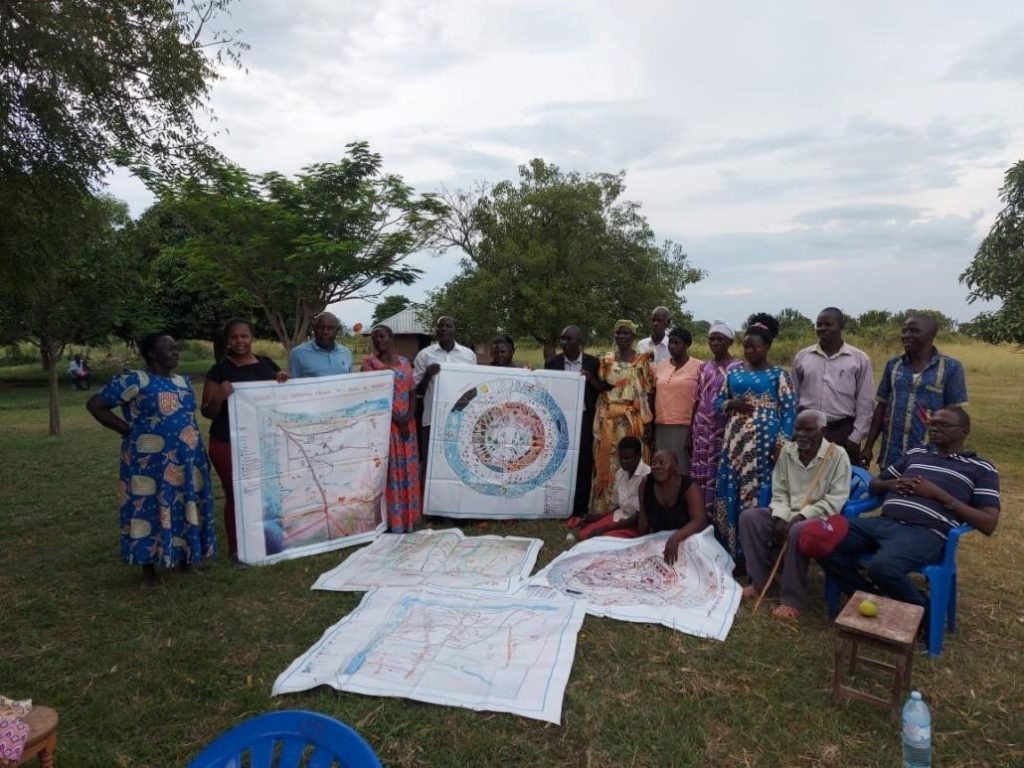
Ancestral maps and calendars created by the Bagungu and AFRICE communities.
Sacred natural sites are ecologically and spiritually sensitive areas for these communities. In the case of the Bagungu, there are at least 32 sites located in forests, rivers, or wetlands. “They protect these places, and in doing so, they also protect biodiversity. And they are very scared because many of them would end up being destroyed by the pipeline,” he laments.
They also drew a map of the future. They outlined the ideal situation they believe they should work toward in order to restore forests and wetlands and recover the biodiversity destroyed by various types of human activities that occurred in the past and continue to occur on these lands.
Some steps forward
Tabaro and his people are already beginning to reap the first fruits of their work: ‘In August, the president ordered the Minister of Fisheries to grant authority to the Indigenous communities living in the lake regions so they can take charge of fishing. Our advocacy has helped make it clear that empowering these communities leads to healthier ecosystems and stronger livelihoods,’ Tabaro says.
The president’s order grants them greater authority to protect fish breeding areas, combat illegal fishing, and ensure that the benefits of the lakes go directly to local families.
But there are other battles that are proving more difficult. With the support of the Gaia Foundation, in 2020 AFRICE facilitated the drafting of a pioneering local ordinance in Africa, created by and for the district where the Bagungu reside. It recognized the community’s ancestral laws, as well as the right to protect these sacred natural sites. However, to enter into force, it still needs to be approved by the Government Attorney General. But, five years later, they have still not heard from this institution.
John Gafabusa, leader of the Buliisa Sacred Natural Sites Custodians Association, said via video call: “I hope the government supports us in securing the ordinance. We need to be recognized and respected in terms of protecting nature. It is also critical that ancestral laws regarding sacred natural sites and their protection cover all areas through which the pipeline passes, to prevent their destruction, and extend beyond Uganda.” AFRICE is also lobbying for this.
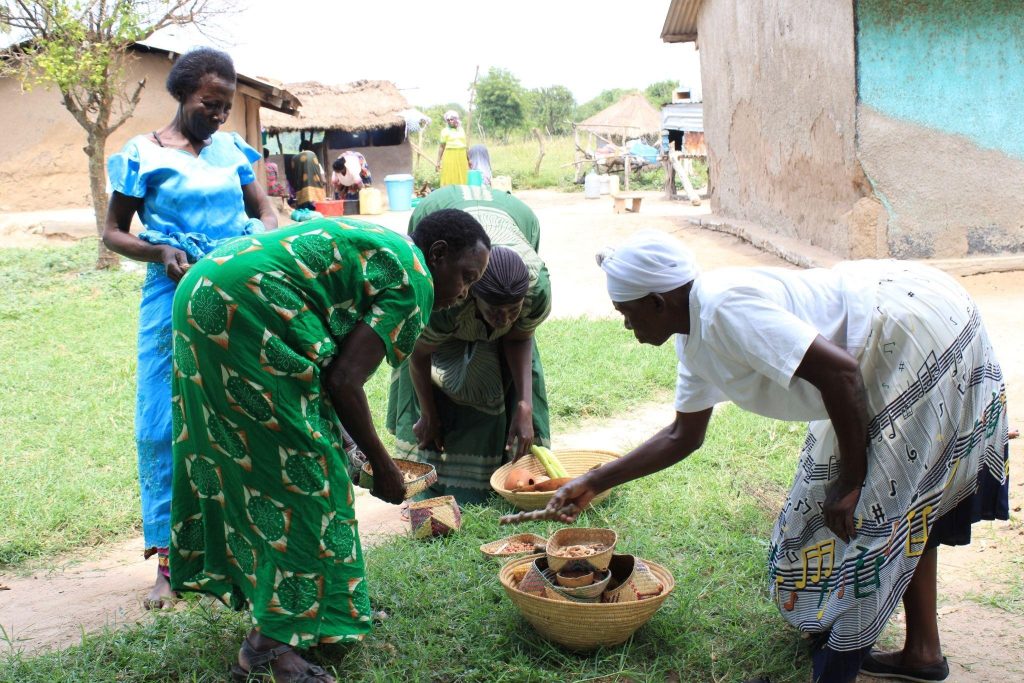
Women seed guardians of the Bagungu community.
An opportunity in a particularly sensitive region
The area where these “sacred natural sites” are located —in addition to the oil fields—is one of the most biodiverse enclaves in Uganda and Africa: it is the region where Lake Albert is located. According to WWF, the area is home to more than 50% of the birds, 39% of the mammals, 19% of the amphibians, and 14% of the reptiles and plants found in continental Africa. And it is where Murchison Falls National Park, the largest in Uganda, was created.
This ordinance, if passed, would make these sacred natural sites off-limits to any person or company. “Oil and gas activities or road construction make this law immediately necessary to protect sacred areas and contribute to the regeneration of ecosystems” the document states.
“Achieving the goal of conserving 30% of lands, waters, and seas by 2030 will require […] collaboration between modern science and Indigenous and local knowledge, as well as adequate financial support and the removal of political barriers that hinder the designation of conservation areas managed by Indigenous peoples.” This is one of the key statements in the latest IPBES report.
However, despite its powerful declaration, it runs the risk of not transcending the academic sphere.
“Uganda is well positioned to lead the way toward decolonized and eco-centric governance on the continent” stated the Gaia Foundation when the Buliisa ordinance was drafted.
In this regard, Tabaro calls on the international community to provide greater support for the Earth
Jurisprudence movement in Africa. “Above all, we need financial resources, but we also need political leaders who pay attention to this. We believe the international community can do a lot to support the efforts of organizations like ours and our networks in Africa and around the world,” he notes.
Author: Ariadna Martínez [Originally published in Spanish in elDiario.es (Spain). Modifying the text in any way is strictly prohibited, as well as copying it without giving credit].